Saturday, February 3, 2018

The World Got Inside

Dear Reader,

Thanks in advance for reading this post. Here’s some context for your consideration. In writing this piece, I’m not looking for answers or solutions from you. I’ve been a teacher or administrator in inner city schools for twenty plus years, and I often don’t know what to do. I’m not expecting you to have answers to my questions, my wondering or my musings. Although if you do, I’m happy to hear them-I could use all the help I can get. My purpose for writing this post, and all future posts is simply to bring awareness to the edu-blogosphere that schools like ours exist, and our students have names, and stories, and hopes, and dreams. I love reading about so many amazing educators, doing phenomenal work with outrageously creative and wonderful students, at tremendous schools. AND, I want you to know about our school too. Most principals and teachers in inner city schools aren’t on twitter, but there are so many schools like mine in cities across America, serving thousands of students in underrepresented communities. The purpose of this post is simply to say we are here, and we are dealing with tough problems, without any clear solutions. And if you think about these stories for even a minute beyond reading the post, or if you share it, or tell someone about it, then my students, my teachers, and our community isn’t invisible in that moment. And I can’t ask for more than that. 

Thank you for reading.
_____________________________________________________________________

There are two competing interests at our school.

First-many of our students will be the first person to graduate from high school in their family, and most will be the first to attend college. We need to find as many ways as possible to connect our students with interesting, and dynamic people outside of the school. The more we can connect out in the larger Cleveland community, the better it is for students. They need to see what Cleveland has to offer if you’re educated and have choices.

Second-Our students live in dangerous neighborhoods. They hear gunshots at night. They cannot travel alone. Most of my students know someone who has died as a result of violence. And the neighborhoods are more often than not, controlled by gangs. Plenty of students at our school aren’t in gangs. But there are also lots of students who have to be gang affiliated, whether they want to be or not. In some neighborhoods, if you aren’t affiliated, you aren’t safe. If you aren’t affiliated, you can’t go outside. If you aren’t affiliated, you aren’t protected. Students have codes, and rules, and expectations that are required in the neighborhood, and my students must abide by them.

I have to juggle these competing interests all the time; Connect our students with the larger Cleveland community and keep the communities our students come from, out of anything connected with our school. We don’t always talk about it, but I’m always aware of these two competing interests. To finish setting the stage, we haven’t had any gang-related issues inside our school, for years. Everyone coexists, regardless of what neighborhood they come from, inside our school walls. There’s lots of reasons for this, ranging from specific things we’ve done to create a safe school environment, to the reality that everyone just needs a break from the violence of their neighborhoods, and school is an agreed upon safe zone. Three or four years, ago, I don’t remember which, a dangerous gang member enrolled in our school after his release from jail. He made it until lunch time on his first day, before he tried to intimidate other students, and make it known that our school would be his territory. His actions led to a brawl in the cafeteria, which led to a whole lot of police racing into our school to help me break up the melee. That student ended up violating his parole shortly thereafter, and I’m pretty sure he’s still in jail. Although we continue to take a hit on our state school report card because even though he only attended our school for about a week, and he was suspended for most of it, ours is the last school he attended, so he counts against our graduation rate. But that’s another post entirely. All that is to say, I can’t think of another gang-related issue that occurred at school, in forever. Until last Thursday.

There was a fight at the bus stop at dismissal. I was working with my math department-we were talking about instructional practices-so I missed the fight. But six boys, and one girl fought. Believe it or not, boys never fight at our school. Girls fight more than I want-but it’s never an issue with boys. This time there was an issue, and after the police helped me to clear the area, I had to determine what happened and why. The short version is the following. Two boys, fought over a girl, two boys fought because they don’t like each other, and the other kids jumped in to support their friends. Unfortunately, all the kids are either in rival gangs, or affiliated with rival gangs. That night, one of the fighters posted a video on Instagram (the bane of my existence). In the video, which we now have, he clearly says a bunch of stuff that I can’t write in this blog post and feel comfortable with it existing on the internet. So I’ll take just a bit of creative license and say he said, “Fuck the dudes from (this neighborhood.)” This very brief video reached gang members with no connection to our school, from both neighborhoods. Then, a second fighter, from the other gang, posted a video naming people who were going to get hurt on the first gangs’ side. But by Friday morning, I was still putting together the reasons for the fight, and I didn’t know about the videos yet.

10:00 AM Friday

A student brought a third video to our attention. I knew about the other two at this point, but we hadn’t seen them yet. In this third video, a student I didn’t know, from another school, was saying he was coming to our school on Friday afternoon to fight. We made a police officer we know aware of this video, and together we figured out what school he attended. The police officer agreed to talk to the student at the other school.

10:45 AM Friday

The police officer reports that he’s handled the other student, and he won’t be coming to our school to fight. I think I have the situation under control.

11:00 AM Friday

My boss arrives at school for a scheduled data meeting. We’ll be going through our individual student data to discuss who’s on and off track to pass the required graduation exams.

11:30 AM Friday
Students start telling adults at school that a whole bunch of dangerous people are descending on our school that afternoon.

12:20 PM Friday

Students report, during our second of two lunches, that two guys were trying to sneak into our school building. We end the data meeting, so I can address safety issues.

12:30 PM Friday

We confirm that multiple students and teachers saw two people trying to sneak into our building. I put the school into a Code Blue Lockdown. Code Blue means that no one can enter or exit the building, all staff and students have to remain in place, but teaching and learning can still continue.

12:31 PM Friday

My security officer and I search the building from top to bottom to ensure no one got into the building and to make sure there’s no way into the building. As we finished our search, the School District Police arrive.

For the next thirty minutes or so, we tried to figure out what we know and what we don’t know. We’ve got great relationships with our students, so we called in students who we knew would talk with us, who were also gang affiliated. They confirmed for us that gang members from both gangs were descending on our school. A couple of words of explanation here-My team and I have great relationships with our students and I rely on those relationships everyday, all the time. But when gang members from the neighborhoods descend on our school, those relationships don’t matter, because I don’t know anyone that’s coming. These are guys who are loyal to their gang above anything and everything, and they don’t know me, and don’t care about our school. My best tool is rendered useless under these circumstances. We asked our students to try and call off the masses from showing up at school, and they tried for sure. But it didn’t work.

1:30 PM Friday

I took the school out of lockdown. We were safe inside the building, so no need to stay in a lockdown, but I know it’s going to be dangerous outside of the building, so I need a plan to dismiss teachers and students safely. I don’t have one yet.

1:50 PM Friday

My security officer recognizes the two guys who tried to get into the building. They are about a hundred yards away, at the bus stop outside of school. The police head out to talk to them, and they say they are just waiting for the bus. We know they are lying, so we watch. I’m still working out the plan to get everyone out safely.

2:15 PM Friday

The bus comes and goes and the guys don’t get on. A jeep that we hadn’t noticed pulls up outside the school, and a whole group of guys step out. Two more guys appear from beyond my line of site. They are all talking with the bus stop boys together. We don’t know which gang this is yet, but they are clearly there waiting for dismissal.

2:16 PM Friday

Our 9th grade team all has off last period, so they can plan together. I decide to use a trick I learned in New York City to take advantage of the idea of safety in numbers. I ask the 9th grade teachers to station themselves at all doors at dismissal to ensure that every student has to exit via the front doors. I have my Campus Coordinator and my Security Officer stationed at the front doors. The plan: Funnel all students to the front doors, but don’t let them out of the building. Keep the front doors closed until everyone is gathered at the doors, then open them, so the whole school walks out in one big mass at the same time. It’s harder to attack any individual when such a large group is on the move together. I decided to use the same plan for the teachers. I called on a teacher-leader to spread the word to all the teachers. They would meet in the underground garage at dismissal, and wait until everyone was ready to leave, and then leave as one group. The garage door would open and close just once.

2:18 PM Friday
My wife calls to ask me to pick up pull ups. I prefer to tell my wife about these incidents once they are over. No good can come from talking about it as it’s happening. Telling too soon will just cause unnecessary fear. So we discuss pull ups. And the weekend plans. Sometimes my suburban middle class life collides with my inner city experiences, and it’s either absurd, insane, or both. This is one of those times.

Dismissal is at 2:30. And between 2:16-2:30, more police arrived to help outside the school. I didn’t tell the students what we were doing and why, and I didn’t tell the parents who pick up each day outside the school. I didn’t want to cause a panic.

2:30 PM Friday

We gathered the students at the front doors and they left en-masse at about 2:34 PM. The teachers drove off a few minutes later, and the inside of the building was empty and secure. But the outside was another story.

I escorted students to cars and chatted with parents, while always keeping my eyes open for the danger that was around us. But I stayed close to the school doors. For years, I used to jump into these dangerous situations. I went into the fray, always, because I felt like I needed to be there to keep my students safe, to help keep the calm, and to be level-headed. But I have two young sons, and I’ve learned that I can keep everyone else self, and also keep myself safe. I didn’t always know that truth, but I do now.

The police handcuffed detained the two guys from the bus stop to be safe. Other officers found the other gang waiting a block away, at an alternate bus stop that my students use. In total, we had between 10-15 gang members outside our school. Some had guns. And those are just the guys I know about.

2:40 PM Friday

I headed to the bus stop near the school to ensure everyone gets on the bus safely. I’m there, but I’m also there with the police.

2:45 PM Friday

My wife is running an event that evening so I need to pick up my kids. I realize I’m not making it to my son’s elementary school for pick up, so I begin leaving messages with friends to help me out. “Hi, it’s Eric, I’m not going to make it to dismissal on time. I’m dealing with a police issue. Can you pick up my son, and I’ll get him at your house?” (See comments about worlds colliding above.)

3:00 PM Friday
Everyone is safe and I thank the police for their support. We discuss how we haven’t solved anything, only delayed it and we agree to meet again on Monday to figure out how to actually solve the problem. I race to my car to head to get my kids. There’s no traffic and I’m able to get to them fairly quickly. But the ride is too short. I need traffic to decompress, but there isn’t any.

I don’t know how to describe how hard it is to switch from inner city principal managing a dangerous situation to suburban dad in way too short a time. Maybe it’s like riding a race car at over 100 miles per hour and then switching to precision needlepoint without a break in between? I don’t know. I picked up my kids, they hugged me and asked me how my day was. I lied and told them it was good and switched the discussion to another topic.

I wish I could say the incident ended there. But it’s a week later, and I’ve spent virtually every minute of every day since then working on this issue. I’ve spent more time with the police this week, than I’ve spent with my wife. I haven’t been in classes, and I haven’t been much of an instructional leader. But I’ve learned the ins and outs of gang affiliations, addressed a dozen kids loosely, directly, and indirectly involved in this. I’ve yelled, been scary, been supportive, and been angry-sometimes all at the same time. I also made time to read with R from last weeks’ post. Fortunately for me, he was out with the flu on Wednesday, Thursday, and Friday. It’s fortunate because I couldn’t have made more time to help him, and that would have set back our very tenuous positive relationship.

Yesterday, the original fighters returned to school. I spent the day threatening, yelling, cajoling, and threatening some more. I ended the day with the police, clearing the neighborhood to make sure no one fought. To be clear, I’m not proud of myself when I have to yell and threaten teenagers. I see all these wonderful tweets about how we ought to talk to kids, and how to be inspirational in school to get the best out of students. It hurts me every time I have to talk to students this way-but no one can learn if they don’t feel safe. And both learning and safety were in short supply this week. And sadly, sometimes inspiration, goodness, and hope isn't enough. Needless to say, all the yelling meant it wasn’t my best day as a principal. These gang issues took up an entire week. And I mean almost every minute of an entire week. Letting the world sneak into our school, led to the dam breaking, and I couldn’t stop the world as it swept into our building. And now I need to rest, so I can get back here on Monday to keep the world out and get back to us having some semblance of a school with teaching and learning as the focus.

In order to help these students to grow and cultivate dreams that can be achieved, I have to connect them with great people and ideas in the larger community. To have the life they deserve, they must connect with the community. But to have the life they deserve, I also need to keep the community out of the school. It’s the community that creates danger, and teaches us that hopes and dreams can never become a reality. Connect with the community; and keep the community out. Both. Always. At the same time. Striking this balance is an unbelievable challenge. How do I do it better than this past week? Sometimes I think I know. And sometimes I’m positive I don’t.

Until next week...


Saturday, January 27, 2018

A Hard Truth

Dear Reader,

Thanks in advance for reading this post. Here’s some context for your consideration. 

In writing this piece, I’m not looking for answers or solutions from you. I’ve been a teacher or administrator in inner city schools for twenty plus years, and I often don’t know what to do. I’m not expecting you to have answers to my questions, my wondering, or my musings. Although if you do have some ideas, please feel free to share-I could use all the help I can get. 

Instead, my purpose for writing this post, and all future posts is simply to bring awareness to the edu-blogosphere that schools like ours exist, and our students have names, and stories, and hopes, and dreams, and struggles. I love reading about so many amazing educators, doing phenomenal work with outrageously creative and wonderful students, at tremendous schools. AND, I want you to know about our school too; even though not all the stories have a happy ending. Most principals and teachers in inner city schools aren’t on twitter, but there are so many schools like mine in cities across America, serving thousands of students in underrepresented communities. 

The purpose of this post is simply to say we are here, and we are dealing with tough problems, without any clear solutions. And if you think about these stories for even a minute beyond reading the post, or if you share it, or tell someone about it, then my students, my teachers, and our community isn’t invisible in that moment. And I can’t ask for more than that. Thank you for reading.
_____________________________________________________________________

I have a 9th grade student; R, who is very difficult in school and at home.

Our building is a square, with all the classrooms around the outside of the square and open in the middle. R can most often be found, running around the outer edges of the building to avoid classes and adults. R is very immature, and very whiny when he’s confronted with his inappropriate behavior. Sadly, he’s not so nice to talk to. He is prone to angry outbursts, and over-the-top temper tantrums. As educators, we don’t often say this, but the truth is-R isn’t a very likable kid. And, in addition to not being particularly likable, and his bad behavior, R can barely read. He’s fourteen years old, and he’s only a slightly better reader than my own six year old, first grade son.

Can you imagine not being able to read? I can’t-not really. I love to read. I’ve always loved to read. Reading keeps me sane, and I make time to read every night, no matter how exhausted I am from the day that was. There are certainly classes I struggled with in school-but reading, well, I can’t remember a time that being a reader wasn’t a part of who I am. But for R-reading hasn’t ever been a part of his life. It’s like the books at the library are all in locked, glass cabinets. He can see in, but he can’t get to them. And if he could ever get to the books; what could he do with them?

This week, R was having a particularly difficult day. He skipped multiple classes, and ran his normal route around the building. As I mentioned, our building is a square, so as long as I position myself along his route, eventually, he’s going to run right into me-and that’s what happened. As I brought him to the office, the cursing began. “Fuck you, bro.” was the main insult that came my way repeatedly. It went on and on, and escalated in volume, to the point that my custodian/basketball coach came into the office to try and calm R down. No luck there either. I left the office, to handle another issue (fun day!), and my PE teacher tried to speak with R. Upon my return to the office, every adult within earshot said in my absence R had threatened to “beat the shit” out of my PE teacher and out of me.

As an aside, just in case you are wondering, people threaten to hit me fairly regularly-I usually hear that threat a couple of times a week. But I’ve only ever been purposefully hit by a student once in twenty-two years, and I’ve been threatened at least a thousand times. That one time getting hit wasn't any fun at all, but my point is, although I hear it all the time, it’s almost always just an empty threat.

As R escalated his behavior, I asked my secretary to call his mother to come in and meet with us. When she arrived, R’s behavior got significantly worse, and he directed equal amounts of ire at his mother as at me. We sat down in my office, and R began by turning his chair away from me. I’ve got a bunch of tools in my toolbox to encourage students to de-escalate their behaviors, so without offering every detail, we got to the point where R was sitting quietly and listening.

I began. “It’s time for a hard truth.

You can’t read.

You’re expected to graduate in May of 2022, and you aren’t going to. You’ll drop out before then because you can’t read.

You can’t get a job, because you can’t read the applications.

You can’t do any tasks that require the most basic reading skills.

You’re going to be living with your mother for the rest of her life, because without being able to read, you have no choices, and no opportunities.

You show up at school, but being here isn’t the same as learning. You can’t read.

You can say ‘fuck you, bro’ as many times as you like and you still can’t read.

You can threaten our PE teacher, and you still can’t read.

You can threaten to hit me, and you still can’t read.

You can run around the building day after day and you still can’t read.

We might be able to help you, but you won’t let us, and you still can’t read.”

I continued. “If I could go to your elementary school and yell at them for passing you through to us year after year, I would. I can’t imagine what it feels like to sit in classrooms day after day, year after year, and not be able to read. It must be so scary and I know I’ve never felt anything like that.”

I never got into a fight when I was a kid. But I’ve always been able to punch with words. I joke sometimes with my students and staff about words hurting. But I took it a step further than just hurting. I eviscerated a fourteen year old boy. By the time I stopped talking both R and his mother had tears running down their faces. Was I too harsh? I wonder what you, the reader, thinks about my words? Perhaps you speak to students this way also? Or maybe you aren’t in schools where these conversations need to happen? What bothers me is not that I made R cry, or that I had to speak harshly to him. What bothers me is that I’m the first person to have this conversation with him. His mother knows he is a struggling reader, but she hasn’t ever spoken to him in this way. And what about his former teachers and principal? I don’t know. As I mentioned, R isn’t particularly likeable. He’s just the kind of kid that gets passed on, whether he learned or not.

So now what? Honestly, I have no idea. I don’t have anyone on staff who who is reading certified or has any idea how to teach a fourteen year old to read for the first time. My current plan is to pull him out of science class as often as I can, and teach him how to read myself-as best I can. To be clear, I’m not a reading teacher either. But I am a learner, so I’ll do my best. Can we help R? I really don’t know. I don’t ever give up on students, and I’m not starting now. But the mountain ahead of R is pretty damn big.

R is my most disruptive non-reading student, but he isn’t my only one. I have three. R, another 9th grader, and a 17 year old, who is trying to repeat, 9th and 10th grade classes, and take 11th grade classes, while barely being able to read-all at the same time. I’m supposed to know what to do. I’m supposed to have the answers. But I don’t. If you have any suggestions, I’m all ears. Oh, by the way, in addition to these three students who are essentially non-readers, I have another another seventy students across 9th and 10th grades who read between a 2nd and 5th grade reading level. Any suggestions? How similar is this to your experiences?

These are our students and our challenges. As I’ve mentioned, the work is incredibly hard. And when we fail, students end up living in poverty, or in jail, or with the life they have to have instead of the life they choose. Time to get back to work.

Until next week….

Saturday, January 20, 2018

Is It Getting Better?

I write mostly about my experiences in our inner city school. I purposefully stay away from the teacher experience for several reasons. First, while I’m still very much a teacher, I’m no longer a classroom teacher. And secondly, it’s next to impossible to write all the contextual pieces that are needed to really understand what it means to teach in our environment. Sometimes what I write is misinterpreted-it’s easy to misinterpret when a reader unknowingly places their often white, middle class values about school, and teaching and learning on my school context. It’s not a stretch to say my school is on a different planet from most edu-blogosphere and edu-twitter users’ schools. So I worry about how my teachers will be perceived if I write about their experiences.

This week, in response to my last post, Matt Mineau asked about the teacher experience at our school, and then again in a google hangout we held a few days ago, he asked, “Is it getting better?” So, as long as you, the reader, agree to direct any of your frustration about teaching and learning at my school, at me, and not at my teachers, I’ll give sharing their experiences a shot.

You know that game, Two Truths and a Lie? It’s the first descriptor that comes to mind in trying to answer Matt’s question of “Is it getting better?” So let’s play the game:
  • It’s getting better all the time
  • Students are learning
  • We’ve never been this good, and we’re still a million miles from where we need to be.
Which are the truths and which is the lie?

Before I answer, let me try and paint a picture of what it is to teach in this environment. Most teachers have classes of 25-32 students. Not terrible, and not great either. Teachers teach five 54 minute periods per day, they have one 54 minute period off, and one 40 minute lunch period. I’ve worked hard to ensure that almost every teacher is only teaching two different courses and not three. Mostly, teachers are broken down into teaching 9th grade only, 9/10, and 11/12. First period starts at 8:00 AM. The doors open for students at 7:30 AM to come in and have a free breakfast. 100% of our students receive free breakfast and lunch. We’re not a neighborhood school, so students come to us from all over the city. There aren’t any school busses for students, so everyone takes public transportation to get to school. We have students who arrive at school with plenty of time to eat and be ready for first period, and we have plenty of students who leave their homes between 6:00 AM and 6:30 AM and the bus drops them off at school between 8:15-8:30. That is absolutely the earliest they can get to school, and they miss most of first period every day. There are seven required graduation tests in the state of Ohio. The tests aren’t terrible. They are assessing learning and application of learning. They are similar in style and scope to the MCAS in Massachusetts and the Regents in New York.

60% of entering 9th graders every single year, read and do math below a 5th grade level. At a meeting for my own first grade son this week, I learned that he scored a 168 on the NWEA, MAP Reading Assessment. I have a group of 9th graders scoring between 185-195. That means they are reading at or around a second grade level-as 9th graders. Just take that in again. My first grade son, who is an emerging reader, is just a little behind a to-large group of my 9th grade students.

Most students have lost someone to violence. Most students live in single parent homes. Most students live with their mother or grandmother. I have several amazing fathers engaged in our school-but most students don’t engage academically with their fathers.

Our students come to school hungry. They come to school cold. They arrive angry. Many exhibit the signs of PTSD-and receive no counseling services. A large group need glasses and don’t have them. A percentage of that group needs glasses, don’t have them and have no idea they need glasses. Picture your own high school or middle school. How many students wear glasses and/or have braces? I think I have two students with braces. And dozens of students who cannot see the front of the classroom because they don’t have access to glasses.

If you came to my school and asked one question- “What vegetable do you like to eat?” The most common answer would be-ranch dressing. There’s a supermarket, and it’s a good one, across the street from my school. But there aren’t supermarkets in any of my students’ actual neighborhoods. Think of the implications of that-there is no access to fresh fruits and vegetables for virtually all of my students. Students start eating hot cheetos, doritos, and soda on their way to school. That’s breakfast, lunch and often dinner. Or McDonalds-McDonalds is common for breakfast and dinner too. Students who never eat anything healthy are grumpy. They get tired easily, and they exist in a perpetual state of hangriness. Students have headaches all day. They are dehydrated, malnourished, and perpetually tired. And then they go to class and my teachers have to figure out how to engage them.

This week, my American History teacher was teaching about Federalism. My World History teacher, Nationalism. In Biology, it was Genetics. And in Physical Science it was Force. In Algebra, it was graphing functions. Pop Quiz: How would you teach Federalism to students reading at a 2nd grade level? A fourth grade level? And if that question feels too abstract, how about this one. How would you teach your elementary aged child to drive a car? It’s the same type of question. How do you teach someone with huge gaps in their knowledge and experiences? How do you teach someone Functions who hasn’t yet learned how to divide? How do you teach Genetics to someone who hasn’t learned cause and effect? How do you teach Nationalism to someone who has never left Cleveland, and doesn’t know that Europe isn’t a country? There are lots of difficult jobs out there. I’m not in the competition game-but it’s hard to convince me there is a more difficult job than teaching in the inner city.

How would you teach students who are hungry, and angry, with gaps in their knowledge, PTSD, and reading many years below grade level? The skills most of us have as teachers only work sometimes in this environment. And there’s a whole other set of skills that you don’t know you need, and have to learn to survive, that are vital to teaching and learning in this community.

When I’m hiring teachers, one of my standard lines is, “We teach kids, not content.” Your love of Shakespeare, or moles in Chemistry isn’t useful in this environment. What’s required is relentless and unconditional care for the kids. We have to like them. We have to believe in them more than they believe in themselves. We have to care deeply about them as people, and not how they relate to or don’t relate to Romeo and Juliet. And it’s so hard. There aren’t words to describe how hard it is. Expert teachers in suburban communities can fail as inner city teachers. The standard set of teaching skills are non-transferable in this environment. Our students curse at our teachers out of anger sometimes, but mostly out of fear. Are you ready to be told “Fuck You” on a regular basis? Sometimes fuck you means what it sounds like. But often it means, I’m lost. I don’t get it. I’m scared. I’m angry. I’m hurt. But every time, it still sounds like fuck you in the way we usually hear it. And it hurts every single time. No matter what the students’ intent.

Our students experience school in a constant state of desperation. Please don’t find out I don’t understand. Our students fear so deeply that despite your best efforts as a teacher, you also won’t be able to help them learn. So maybe it’s better not to try. Our students yell at our teachers. Our students hide in plain sight. They put earbuds in, crank up the music and say with every fiber of their being, “I dare you to get me to care. I dare you to try and teach me.” The notion of readiness to learn is non-existent in our classrooms. School is for sure a place students come to be safe. It’s a place to get warm. It’s a place to get food. And it’s absolutely a place to be compliant. But a place to learn? Not really.

So that’s the context. See why it’s hard to write about it?

Back to two truths and a lie. Did you figure out which were true and which was the lie?

Truth #1

We’ve never been this good, and we’re still a million miles from where we need to be

We’re talking about student learning more than we ever have before. We used to have conversations about safety, and discipline, and law and order, and discipline, and bad parenting, and discipline, and then we’d talk more about discipline. Now, it’s mostly about student learning. We are the best version of ourselves that we’ve ever been. For years, I had as many long-term subs as I did certified teachers. So it was a roll of the dice when walking into a classroom if you would see students engaged in any kind of meaningful task or not. We have chromebooks for everyone now. Teachers are using google classroom, nearpod, and other tools to engage students in the content. We have tools, we have structures, and we have systems in place to have the highest level of engagement we’ve ever experienced.

Truth #2
It’s getting better all the time

We have the best set of teachers our students have ever had. Every year, we add something new and positive to our academic program. My teachers are immersed in the difficult learning of incorporating literacy skills across the curriculum. It’s hard work. And most of them are killing it. Remember before I listed some of the topics students were covering last week? Federalism, Nationalism, Genetics, and Force. Now add to those already difficult topics, teachers incorporating instructional tools and strategies so students can specifically grow their very low literacy skills. High school teachers don’t think of themselves as reading teachers. And our teachers don’t either. But they’ve taken on the challenge of incorporating literacy everywhere possible. My PE teacher has students reading articles and using graphic organizers as part of the learning in her class. We’ve never approached anything like that before and it’s vital to support our students in the manner in which they need and deserve.

The Lie

Students are Learning
Students are compliant. Students are engaged in tasks and activities. Students are doing more relevant work than ever before. But I can’t yet prove that they are learning. Is every class in every high school about learning? I wish the answer was yes, but it’s not. It’s my seventh year as the principal of our school, and I can’t say definitively that all students are learning. Does that make me a bad principal? Maybe. Does it mean I have terrible teachers? It could. But I would challenge anyone reading this to come to our school and do it differently and better. It’s so damn hard.

Back to Federalism, Nationalism, Genetics, and Force. There are so many better ways to teach those topics than what we are using. PBL, Design Thinking, Genius Hour, and on and on and on. But our students have no idea what learning looks like. For them, school has always been an exercise in compliance. Not only do we have to teach students to read, but we have to teach them to learn. For most of us, if we decided to run a marathon, we’d have to train for it. I’d die if I had to run a marathon tomorrow. If we want to play in a band, we have to learn the instrument and practice, and then practice some more. But everyone just assumes that students know how to learn, just because they showed up at school. Our students don’t know how. And the absence of knowing how to learn, means the absence and evidence of actual learning.

Currently, I’m teaching my teachers to differentiate content, process, or product in their classrooms. They don’t know how to differentiate? They do, at your schools. What they don’t know how to do is teach Federalism, Nationalism, Genetics, Force and Graphing Functions to the couple of students who are at or above grade level, to the 10 students who are a 5th-8th grade level, and to the 15-20 students who are well below a 5th grade level, all at the same time-while also teaching literacy skills, and trying to teach students to be learners. Do you know how to do that? If you do, please come help. I’m teaching every day. And my teachers are learning it. Slowly. And they are incorporating it into their classes while learning it themselves-and that’s not easy to do.

Learning is the last mountain to climb. Are we getting better? Yes. Is it enough? No. It’s not close. If you have any thoughts on how to do this differently, or better, please come on over. We all want to do better for our students. And our students need us to be better at a faster rate than we can possibly improve in reality. Their lives at actually at stake. And so we press on.

Until next week...

Saturday, January 13, 2018

The Cycle of Care, Empathy, and Engagement

There are no students at my school who enter 9th grade, stay four years, attend classes, excel, engage, and graduate as planned four years later. Not one. Not ever. The journey is filled with starts and stops, failures and more failures, fear, self-sabotage, and self-doubt. Generally, students come to us in 9th grade and hopefully they enter only two to three years below grade level in reading and math. Hopefully. Most enter 9th grade reading and doing math below a 5th grade level. But that’s not the bad part. They’ve been passed along in elementary school, learning from their experiences that good kids move on to the next grade, bad kids move on to the next grade, struggling students move on, and those who excel move on. Success is measured by compliance, not learning. So students enter 9th grade knowing, from all their lived experiences that showing up at school is what is needed to advance to the next grade; compliance, not learning is king. Add to this equation a healthy dose of inner city issues-be it poverty, trauma, loss, or violence, or maybe all at the same time. Then add a just a dash of puberty and the teenage sense of invincibility that comes with it, and we have ourselves the educational molotov cocktail entering our school doors on the first day of 9th grade. One hundred of those educational cocktails enter our doors in August.
Then the work begins. I use the term work, but it’s really a war. We fight daily for the hearts and minds of our students. We fight daily to plant the seeds, then to cultivate, and grow hopes and dreams for a positive and most importantly, a named future. We fight daily to shift from compliance to learning. We fight daily to teach skills. We fight daily to teach students to view themselves as learners. We fight daily to make our small school the eye of the storm so the violence of the neighborhood and the despair in the community can knock at our doors, but it cannot get inside. We fight daily to care about students, empathize with students, and teach students the tools to engage on their own as graduates with self-efficacy and agency.
I think of this fight as a cycle of Care, Empathy, and Engagement. Sometimes one leads to the other, and sometimes they are concurrent. Here’s a profile of three young men at different stages in this cycle.

D, T, and A

D enrolled at Design Lab in August of 2013. I don’t remember how many years below grade level he was when he arrived, but I know for sure he wasn’t close to reading or thinking, or problem solving on a 9th grade level.

T enrolled in August of 2014. Soon after his arrival, we lost our 9th grade history teacher and 9th grade English teacher for the year, and I couldn’t find certified replacements for months. T spent most of 9th grade taught by substitute teachers.

A enrolled in August of 2017. He came to our school because his sister graduated last year, and his mother believes we can get him to the finish line. A is on grade level as a reader. But he’s in and out of the juvenile detention center and he keeps on violating his parole.

D began stealing everything that wasn’t nailed down at our school soon after he arrived, but it took me awhile to figure it out. He played and laughed all the time, and by the end of first semester of 9th grade, he had failed every class. In February of 2014, as D continued to fail every course, I was able to purchase chromebooks for every student. We went from having six desktops in most classrooms, to a computer in everyone’s hands. I lacked systems and structures to manage the chromebooks and students started stealing them soon after I put them into use in classrooms. D continued to come to school every day, although he learned nothing.
Sometime in the spring, I figured out that D was the primary chromebook thief. I confronted him, scared him, and tricked him into admitting his crime by pretending I had more information than I really did. He had at least a dozen chromebooks at his home, and another bunch at a friend’s house. But he had sold many to a store that bought stolen goods from anyone willing to sell. He had sold enough computers to ensure a felony theft charge would follow him for the rest of his life. What to do? He had broken my trust. He had stolen from our school. And I intended to expel him and have him arrested to show the rest of my school what happened to computer thieves.

T spent most of 9th grade actually running through our hallways. His teachers couldn’t handle him, and he had a partner in crime who encouraged every bad behavior you can imagine, and many you can’t. T was either quiet in class or outrageously disruptive. When quiet, he spent most of his time, with his hood up to hide his headphones. He could tune out whatever the teacher was saying by listening to music. Depending on the course, he either failed quietly, or loudly. But he failed them all. He alternated between invisible with some teachers, and angrily cursing and yelling at others. T lives in a neighborhood where he must be in a gang to survive. There is no choice, and he started skipping school more than he attended school. Every time he returned we talked privately. I challenged him to either drop out or engage in school. I told him his circumstances outside of school could control, and ultimately end his life, or he could take charge of his own life and make something better. He never fully engaged; but he never left either. T has been coming to school, and trying to be a ghost for years.

In the first week of school this year, A cursed at a teacher. The teacher asked him a question, about whatever the learning was intended to be, and A’s very clear answer was “Fuck You.” When A got to me, I told him that how he talks to people matters, and our conversation degenerated from there pretty quickly. Within seconds, we were nose to nose, and A hadn’t threatened me yet, but he was ready to hit me. We were inches apart, and I whispered to him, “If you hit me, you might knock me down, but you will end up leaving this building in handcuffs. How do you win this?” I could see A thinking it through. He cursed at me to save face, and took a step back and sat down.

I brought D’s family in to my office to tell them he was being expelled. As I remember it, two uncles and his mother came to the meeting. One uncle said nothing-he just sat there filled with rage; either at me or D, it wasn’t clear. The other uncle talked about D as being the hope of the family. He was to be the first to graduate from high school. He was to be one of the only men to stay out of jail. He was the one who would make it; how could he have done this? And his mother sat quietly, seething. I hadn’t told them what my plan was, and before I could, D’s mother, in a voice filled with loss and anger said, “Kick him out of your school. Have him arrested. I’m done with him.” And then she stormed out, slamming the door behind her. I sent them away, without making a decision, and told them to come back the next day.
I didn’t expel him, and I didn’t call the police. I decided that what D needed most was care. If he were to fail, let him fail knowing that he did it to himself. Let him fail knowing that someone was there by his side, and his failure was his, and his alone. And maybe he wouldn’t fail. The uncles came back, and this time, I had my custodian, and my basketball coach/assistant custodian, with me. I told D he wasn’t expelled and I wouldn’t be calling the police. I told him he couldn’t transfer to another school, no matter what, and if he tried to, I would call the police about the chromebooks. And I told D he owed me a debt. He needed to volunteer to work at the end of each school day and during school vacations, including summer break to work off the monetary debt. But the debt could not, and would not be fully paid until he graduated from high school.

T was shot last year in a gang-related incident. I still don’t know the whole story, nor do I want to. But some people came to his house and shot at the windows. Subsequently, T ended up shot in the foot. I never heard the full story, but he stayed out of school for months. The cover story was he couldn’t walk, and that was partially true, but the real story was he and his mother feared that leaving his house would result in his death. So he stayed home. I tried to convince him to withdraw from school, so he could be in an online program, to have some chance of doing something school related in his absence. But his mother told me that withdrawing from our school meant he would never graduate. He was staying. No matter what.

I’ve suspended A over and over again in the first semester. He is so angry. His mother refuses to come in most days; she says he’s too difficult. He’s either in class for the entire period or kicked out within seconds of arrival. There’s rarely an in between. He’s failed every course in the first semester, and our testing to check for readiness or lack thereof for the state graduation tests, tells us he’s learned absolutely nothing in the first semester. His behavior before Winter Break got progressively worse, to the point where I called his probation officer four days in a row. Although I didn’t know it until we returned from break, A’s behavior in school, resulted in him spending a week in lock up at the Juvenile Detention Center over winter break. He blames me for his time in lock up.

D’s mother never stepped foot in our school again. He worked summers and vacations, and even when we told him he had worked enough, he asked to come back for more. The story isn’t a happy one after I let him stay. He gave up, over and over again, and someone always had to pick him back up again. First it was my custodian who became his mentor, and caregiver and taught him what hard work looked and felt like, and what it meant to take pride in a job well done. Then my assistant custodian/basketball coach took up the mantle and became his caregiver-teaching him resilience, toughness and to never give up. Later my Campus Coordinator taught D the content he needed to pass the last two state exams standing in his way. Her care and willingness to make time to teach D, when she clearly had no time to give, allowed him to cross the finish line. And I, I did what I do. I was the eye of the storm, offering care when none was warranted. I cared by being angry for D, and occasionally angry with D. I cared by offering him a glimpse of what the future could hold. I empathized when he wanted to give up, picked him up when he fell, pushed him when he needed it, and cheered as often as possible.
On December 21, 2017, he graduated. And as I shook his hand, and hugged him on that stage, I whispered in his ear, that his debt is fully paid. After graduation, I stood with his family, and his mother, who I hadn’t seen since that day in my office, told me with tears in her eyes, that D is planning to attend college. We didn’t discuss our last conversation, held years before.
In two weeks, I’ll be speaking to 8th graders who are making high school choices for next year. D will speaking by my side. He’s agreed to share his story with the potential class of 2022. He’s also coming in next week so my Campus Coordinator can help him with his college applications. He wants to attend the University of Akron in the fall.

T sat with my Campus Coordinator earlier this week. He’s 19 years old now, and there’s no chance for him to graduate in May. He’s accepted a job at a factory, and he’s right on the edge of dropping out. But he doesn’t want to. My Campus Coordinator worked out an academic game plan, where, if he does everything, and works incredibly hard, he could graduate in August. I came in to speak with him, and he looked me in my eyes and told me he wants to graduate. I believe him. Can he do it? I don’t know. But for the first time since he arrived, I know that he wants to graduate as much as we want him to graduate. And that’s a start. He’s been shot, missed a ton of school, and has a job he doesn’t want. But he needs to do engage in school. He needs to put in the time. I’m incredibly hopeful I have the opportunity to give him the diploma will have earned in early August.

A came to school yesterday incredibly angry. He started cursing at me immediately and was dressed to promote antagonism and anger. He came to school to fight, not with another student, but certainly with me, and his every action screamed “I dare you to engage with me. I dare you to connect with me. I dare you to get me to try.” I brought him to our Planning Center, the place students go to decompress, or when they need to be taken out of class. He looked at me with such anger and hatred in his eyes, and said, “I ain’t doing anything you ask.” I told him he had a choice. He could pull his pants up, take out his head phones, and leave his phone, his headphones, his hoodies, his do-rag, and a bunch of other items with our Planning Center teacher, or if he intended to keep them all on, he could walk out of the building. There was no in between. He yelled at me, cursed at me, and told me in no uncertain terms how awful I am. My Planning Center teacher stood up and raised her voice in a way that she never does. “How dare you!” she said. “How dare you let this man, care more about you than you care about yourself!” A ignored her words, and said to me, “I’m going to class, and I’ll wear what I want to wear and say what I want to say to whoever, whenever.” I told him if he walked into any class, with any of the items I had demanded he remove, I would physically remove him from the building. “And when you put your hands on me, I will beat you down.” He said. “You may beat me down,” I said, “and then you will go back to jail. It’s your move.” We waited, silently, in a tension-filled office. Slowly, and quietly, without looking at me, A handed all of the items I required to our Planning Center teacher, and I walked away without another word.
A stayed and spoke with her for another thirty minutes or so. While I know what was said, it’s not for public consumption. And then A, went to class. And he had what might have been his best day of learning all year.

D’s story is one that appears to end happily. So far. He’s graduated, but there’s still more to do, and his story isn’t over. T is poised at the precipice. On one side is a diploma with choices for a better future. On the other side, he’s a drop-out at nineteen, living a life he hates. And A’s story is still in the first chapter. Of all three young men, he has the most academic potential. If he can learn to be a positive young man, he could absolutely succeed at a four year college. He can be anything and anyone he wants. But can he stay out of jail? I don’t know. Can he pass any high school class? He can for sure. Will he choose to? I just don’t know.

There aren’t any students in our school for whom the road is easy. We care. We empathize, and we get them to engage. And sometimes it works, and other times it doesn’t. Either way, the cycle continues.

Until next week...

Thursday, January 4, 2018

Disconnected Connections

I’ve never been so connected through social media, and it’s never been this lonely. I hear about the echo chamber that twitter is for many users, and that simply isn’t my experience. Although I’m connected, I haven’t been able to engage with any of the tweets I’ve read for many months. I want to use what I’m reading to grow my practice, and I want to apply the ideas I get from the chats I participate in, but there’s a chasm between what I read, and what I’m actually able to do at our school. 

I last posted on this blog on November 7, 2015. I’ve thought about writing again hundreds of times, but I never do, because it feels impossible to share the context of everything that happens at our school. But the reality is, I need the edu-twitter-verse wisdom to help me move forward. The work is simply too hard to do it entirely on my own and I want to find ways to connect again.

I’m a huge fan of the movie, The Princess Bride. You know the scene when Fezzik and Inigo give the Man in Black the miracle pill and he wakes up. Inigo needs to explain what’s happening to Wesley, so he says, “Let me explain. No, there is too much, let me sum up. So, here’s my version of that:
  • This is my seventh year as principal of Design Lab Early College High School, an inner city high school in Cleveland 
  • I spent the first six years: 
    • Making the school safe. We still have occasional problems, as any high school, and any inner city high school certainly does, but I no longer have to sneak into my house to hide other people’s blood on my clothing from my wife. (#truth) 
    • Finding and hiring and creating positions to bring in teachers who care about kids and have the skills to teach them. 
      • One year, I went an entire school year, 180 days, without a single school day when all my teachers came to work
    • I’ve had cohorts of students who only had long-term subs for years at a time 
    • I filled an engineering position this year, after years of searching for someone who could do the job 
    • Creating a culture where relationships matter with both students and teachers 
    • Creating a culture where the role of the principal isn’t simply to punish students in support of teachers. 
    • Building a community of care 
      • This one remains a daily battle. Care and inner city high school aren’t words that traditionally go together. But we’re making it happen. 
    • Creating a college-going-culture, and having a plan for after high school culture 
      • This one is a daily battle also. We can get students into college, but getting them to stay in college is a mountain we have not climbed 
    • Creating an environment where we are the eye of the storm in our students’ lives 
      • 100% of our students receive free and reduced lunch. They come to us dealing with all the issues extreme poverty brings to the table that you know, and so many more than you haven’t even imagined. 
    • Bringing making, design, and real-world problem solving into our school. 
      • We now have an x-block program, which brings community partners into our school to work with students. Read about it here. 
So what’s left to do?
  • Learning. The learning at our school isn’t nearly good enough. It took me six full years to get to the point where all that’s left to do at our school, is the work that I should have been able to start the first day, of my first year. Improving student learning is all that’s left to do. And I’m not sure I know what to do. 
Here’s the reality of where we are: 
  • Between 50%-60% of my incoming 9th grade students read and do math below a 5th grade level when they arrive at our school. I don’t know whether to repeat that statement, put it in bold font, or create an audio recording of me yelling it. Most of those arriving 9th graders are not close to a 5th grade level yet and they have a thousand strategies to use to pretend they know how to do school and to avoid learning. 
  • Imagine barely being able to read as a high school student 
  • Imagine believing you can graduate because you’ve been passed on so many times already, and not understanding that if you can’t pass the graduation tests, you can’t graduate. 
  • Most of my teachers have classes of 25 to 32 students. In those classes are students reading at a second or third grade level, a fourth and fifth grade level, at grade level, and above grade level. It’s an incredible instructional challenge for my team. 
Winter break is coming to an end and my teachers return to school on Monday. Students will return on Tuesday. I think I’m going to try to write about my efforts to grow instructional practices and increase student learning over the rest of this year and into next. My intent is to try and write one post per week. Hopefully, I’m up for the challenge. I’ve spent the last two days diving into our student winter data. And here’s our current reality. Simply put, the students in the middle-those just below or close to grade level are learning. We have tangible evidence to show they are improving. But the students who are extremely far behind, those far below grade level just aren’t learning. And the students who enter our school above grade level-they aren’t learning enough either. My teachers know how to teach to the middle. Differentiating for those so far behind, and those who are ahead is incredibly difficult. It’s not impossible-but it sure is hard. It isn’t that no one is learning. Part of the problem is that students are learning-but not nearly enough. Somehow, I have to figure out how to help teachers grow students more than one year within a year. We have some learning occurring, but a student who enters our school reading at a third grade level (3rd grade!) who improves a year, is reading at a 4th grade level at the end of 9th grade, a 5th grade level at the end of 10th grade, a 6th grade level at the end of 11th grade, and a 7th grade level at the end of the 12th grade. And despite that students’ progress, she isn’t graduating from high school, and she isn’t ready for the world after high school. Additionally, I don’t value teaching to the test. I value design, and making, and real-world problem solving. I’ve spent the last six years bringing these elements into our school in meaningful ways. But it sure is difficult to make problem solving and problem finding the focus when students have such low skills.

I’ve spent my career in schools like mine. But this is the first time I can’t say that all the problems that come with inner city education stand in the way of getting to the learning. I’ve done a good job of addressing everything that gets in the way of learning. Now I’m left with students who don’t know how to learn, teachers with the best intentions, who don’t know how to teach such a huge range of learners, and a lack of learning systems to meet students where they are and take them where they need to go.

It was incredibly daunting to take on the opportunity to lead Design Lab almost seven years ago. It felt like a monumental task ahead when I began. Today, we’re the best we’ve ever been; but we’re not close to being good enough. And as this very-needed vacation comes to an end, the task ahead feels more daunting than it ever has. There aren’t too many people to turn to for advice in this work. There are a million tweets about engagement and assessment and mastery and design, and phenomenal project after phenomenal project that students are doing at schools across the country. And I want to find connections, but the grand canyon exists between what you are tweeting about, and what I am doing.

Does anyone want to chat about how to get high schoolers excited about reading when they can’t find themselves in any books, and they really should be reading books at a second and third grade level? What a challenge.

Does anyone want to talk about teaching students who have been taught only to comply and complete worksheets how to ask why, and what if, and I wonder?

Or about how to teach teachers to differentiate for these enormous range of students in their classes without asking them to create a different lesson plan for each student?

I don’t expect any answers, but I sure would like to connect. I miss the connections in the edu-blogosphere. Sometimes just the dialogue helps.

Until next week....

Saturday, November 7, 2015

Learning by Doing: Teacher Edition

I’ve been power-pointed to death. My personal least-favorite professional development day is to have presenters read powerpoint screens to me as their presentation. Inevitably, the screens are jam packed with words, quotes, and data, and the participants are expected to sit as passive recipients of the eloquent reading of slides by the presenter. Oh, and it’s even better (read worse) when the presenter is kind enough to print out all of his or her slides in a single-sided stapled packet, so we can read ahead on the magic that is to come. I loathe these meetings. I’ve got one on Tuesday. It’s an 8:00 AM to 5:00 PM Principal meeting with one break for lunch. That’s it. The rest of the day I will receive information and I’ll walk away with multiple powerpoint packets of paper that I’m likely to never look at again. Frankly, I’m dreading it. I’ll settle in and do my best to be respectful of the presenters and their message, and the content they are imparting, but it’s awfully difficult to pay attention and stay engaged as the receiver of information for nine hours minus a forty-five minute lunch break.


But I also know that as I write this, one or more of Tuesday’s presenters are currently agonizing over how best to deliver their important information to us. There are 100 principals in our district; new, veteran, struggling, and expert. There are elementary schools, high schools, schools with academic application requirements, programs for English Language Learners, and on and on and on. There’s information we have to know from the district and the state. And there’s no guarantee that my principal colleagues and I will read and understand every email sent to us with this important information. So there are nine hours once a month to deliver the content we need. I get it. And I hate it. My Tuesday presenters aren’t saying it, but their actions scream… THERE JUST ISN’T TIME TO BE ENGAGING. So we’re expected to be adult learners and know the content is important and accept it. So I do and I will on Tuesday. And next month too, and the month after that.


Except for one thing. I have to offer professional development to my staff. I stopped calling it professional development (PD) years ago, and I call it professional learning. I’m not so arrogant to believe I’m developing anyone. Let’s professionally learn together. I shifted my language four years ago, and I’m not sure my staff has noticed yet. So clearly I’m doing an awesome job of creating an adult learning environment. I want to be engaging. But there’s so much we have to get through and so little time to do it. And there’s so much my teachers need to know. Now I don’t make power points, because I hate them, but I can deliver a seriously entertaining lecture filled with the information my teachers need. And of course, they hate it. And they show up this week, and next week, and the week after that. And I watch them laughing and talking with each other about their days and their students and their lives, right up until I start talking, and then the haze descends upon them. All except for the group texts they send back and forth to talk about how lame this PD is again. I’m guessing it’s similar to the group text I’ve got going with my like-minded principal colleagues at our monthly meeting. I hate our PD. I hate that it’s not professional learning, and I hate that THERE JUST ISN’T TIME TO BE ENGAGING. Why can’t my teachers just be adult learners and know the content is important and accept it? Especially because we all know that if I’m not there to ensure they do the work, they simply won’t.


As I write this, I’m reminded of Alexander and the Terrible, Horrible, No Good, Very Bad Day. Just take out Day and switch it to PD, or Professional Learning to make yourself feel better.


The 2015-16 school year at Design Lab Early College High School is about learning to Learn by Doing. My colleagues are doing an amazing job of writing about our work so far. Check out Teaching Humans for great posts about our work to date. This post, written by Meghan Paris, my new 9th grade History teacher, might be the most open and reflective piece I’ve ever read. Because I’m not yet the principal I want to be, it didn’t occur to me until October that if I want all my teachers to have our students learn by doing, then I need to model learning by doing with my teachers. And if I’m going to model learning by doing with my teachers, I can’t worry about the time it takes and the content they have to learn. That’s just not how Learning by Doing works. And if I can’t model that with my staff, how can I ever expect them to ask our students to Learn by Doing?


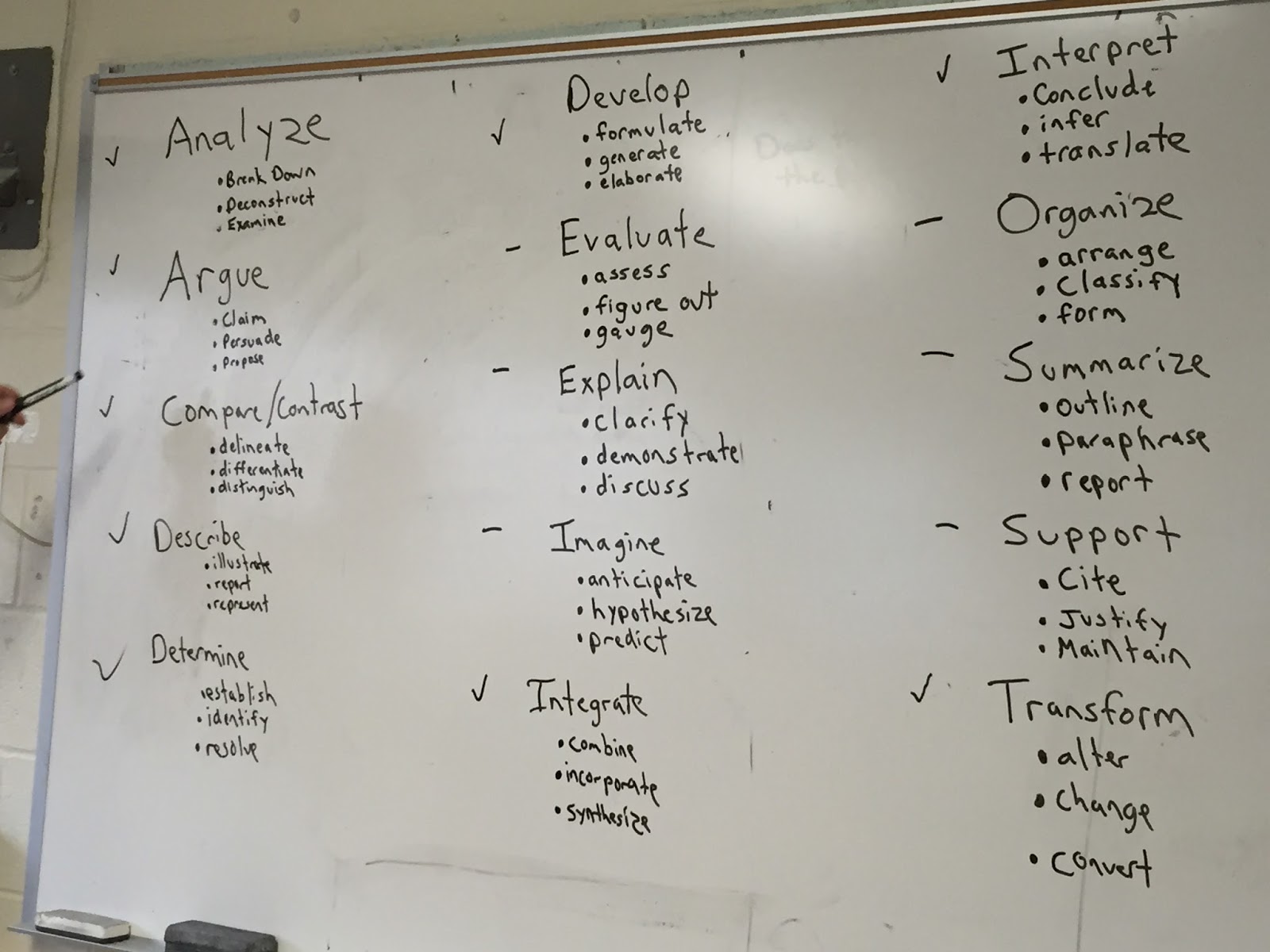
My new partner in this work, Sean Wheeler, and I have settled on fifteen verbs to guide our practice.
They are a combination of Jim Burke and Marzano’s thoughtful works and we’re figuring out how to apply them to our practice at Design Lab. These verbs are omnipresent in the common core standards, state standards, the PSAT, the SAT, and the ACT. But more importantly than all those; we believe these verbs represent real learning across and within content. If a student understands how to analyze something in our Makerspace, then she can analyze in World History and in Algebra 2. If a student can Imagine in our audio production studio, then they can imagine in Biology and Art. If students can transform pallets into aerobic steps, (as our 9th grade has already done), then what can transformation look like in English and Geometry? We believe the application of these fifteen verbs is learning. If students understand the verbs in action, and are aware of them across their classes and how they are embedded in our projects, then they are actually learning. These verbs also can anchor the work for our teachers. Currently I hear teachers say, “I teach Biology, not Reading. What do I do with a student with low reading skills in my Biology class?” With our verbs as the anchor, our teachers can learn to say, “We all teach students to Evaluate. How does that look different or the same from your class to mine?” When teachers are applying these verbs to student projects that are about real problems to be solved, then our students will really be learning.


But if I’m going to get my team there, they have to practice the verbs too. And we can’t just talk about it. I can’t just create a different power point slide for each verb. My teachers have to learn by doing. So I’m shifting our professional development. We started this a few weeks ago, in our time after school, but Election Day was the first opportunity to put my new thinking into practice in an “Let’s totally do this differently” kind of way. There was no school for students, but teachers had a required day of learning. Guess what? It was six and half hours, minus forty minutes for lunch that I get to control. Not quite my nine hour marathon, but still plenty of time for boring slides and nasty texts. But I committed to Learning by Doing. I committed to giving up any traditional structure in the day and I committed to my teachers having the opportunity to apply our verbs in their practice.


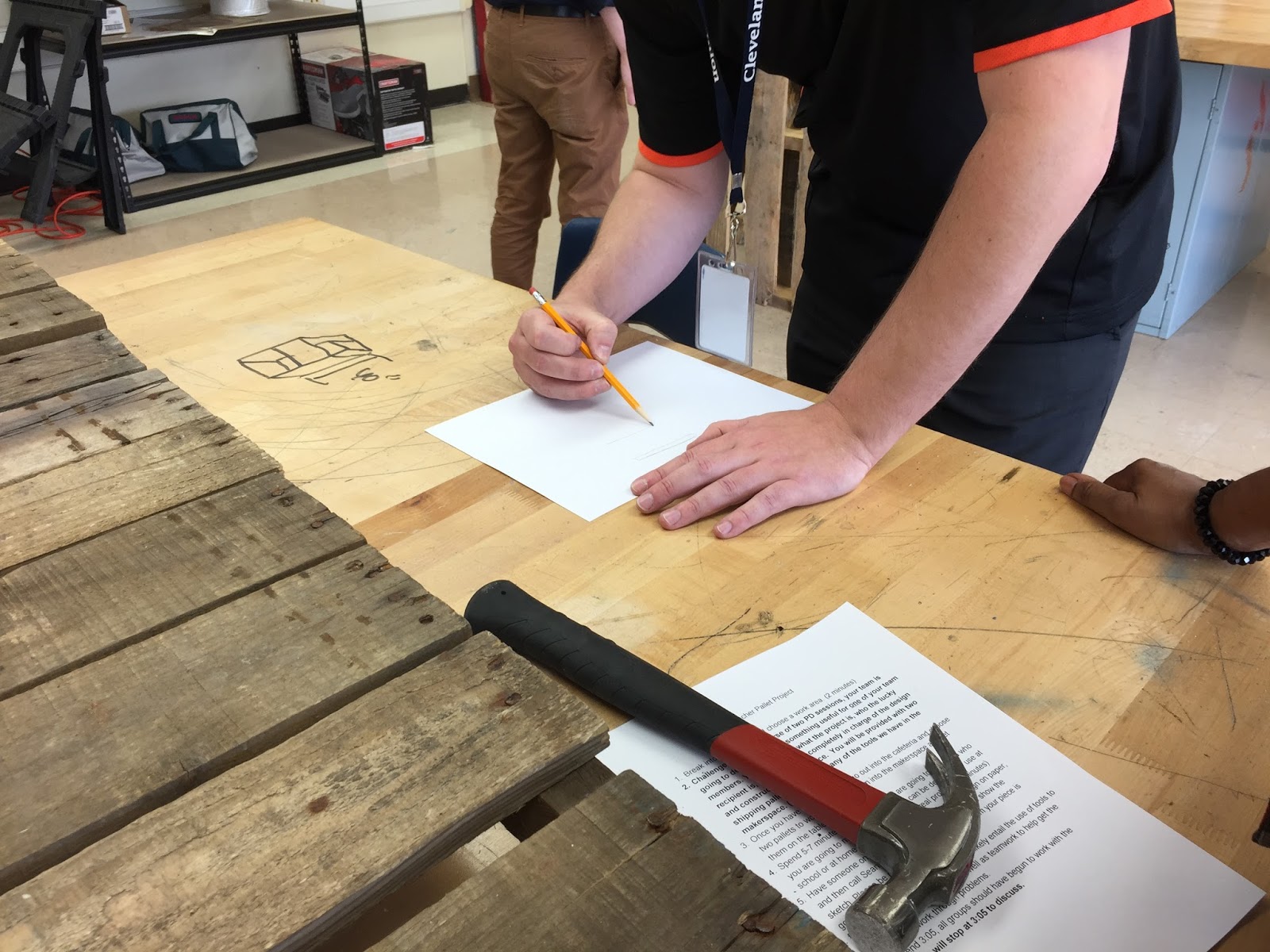
I had one goal for the day, with two avenues to achieve it. The goal: Give teachers the time, space, and opportunity to apply our fifteen verbs in their own learning and practice. We had two pathways to do so; the first a morning activity applying our verbs to our thinking about college readiness and how we get low-skilled inner city kids to be college ready. The second, the rest of the day in our Makerspace, designing and making projects for teachers. What followed was the most beautiful day of teacher engagement, participation and learning that I have ever been a part of since becoming a principal.


I can’t do justice to all the learning that occurred. But here are some pictures and videos to tell some of the story. We are fortunate to be partnering with Pete Debelak, the owner of Soulcraft Woodshop. His guidance and knowledge helped my teachers in their making throughout the day. I watched one group of teachers begin to build screens to convert recycled paper into usable paper for art class. Two other groups imagined and began building stands for laptops and projectors.
I watched my guidance counselor, who had never set foot in our Makerspace learn how to do incredibly complex joinery. Most importantly, I watched teachers collaborate, listen to each other, and support and congratulate each other.
Together, they analyzed, argued with purpose, compared and contrasted options, described their intended outcomes, showed determination when faced with adversity, evaluated decisions and errors, and interpreted data. They began the process of transforming wood, and organized materials. They wondered, discussed, laughed and got covered in sawdust. They had ideas for common tools to use to articulate our verbs coherently to all students in all classrooms. And they had fun. They were engaged.

And they were learning. And did I mention they had fun? And we blinked, and the day was over. There wasn’t time to text because their hands were filled with tools. There wasn’t time to zone out because who wants to lose a finger to the scroll saw?


At the end of the day, teachers took a few minutes to reflect in an open-ended google form I created. And it’s all there-the foundation for Learning By Doing. They reflected about how fun the day was, how scared they were to use the tools, how much they learned together. Are they ready to transfer one day to their own practice with our students? No way. And to expect them to do so right now would be unrealistic and absurd. But they clearly showed me the only pathway to engaging students in this manner across our school, is to consistently engage teachers in this manner at every opportunity. At the end of the day, I realized other than kicking off each activity, I had hardly said a word. And the professional learning, (not development) was off the charts. All that was missing was me working on a project of my choosing, applying the verbs and learning with and next to my teachers.


On Tuesday, while I try my best to receive the content from the presenters, I’ll be planning Learning by Doing sessions for our staff. What does applying our verbs as staff look like long term? I’m also trying to get the nerve up to make a coffee table. It terrifies me, but I have to do this work with my teachers. Otherwise I’m just the guy who tells everyone else to learn by doing.

There isn’t time to waste in our school. Our students are on average three years behind in all academic content. But if talking faster and giving them more content to memorize were going to work, it would have already. Design Lab Early College High School is becoming a school where students learn by doing. High School doesn’t have to be preparation for real life, it is real life. At our school, student learning begins with an actual problem to solve, and ends with making a difference to a real audience. We’ve begun this in the 9th grade. And it’s a struggle. But it’s working. To build this program school-wide, teachers must have the opportunity to actually learn and do this work themselves. And so, we continue in our makerspace, with our teachers learning by doing. I can’t wait to see what happens next.

Wednesday, February 19, 2014

Today I Intended to be an Instructional Leader


Today I intended to be an instructional leader. I knew which classrooms I planned to visit, and what kind of feedback I wanted to give my teachers. I was ready to be immersed in my students’ classroom experiences.

But first, I had a meeting with a student and his father, upon the students’ return from school after suspension. This particular student is new to my school. He’s only been with us for two months. He has one foot in bounds, and another squarely placed out of bounds. He runs the risk of being arrested for some of his actions. He’s also on the verge of repeating the 9th grade for the third time. Usually, I have to be pretty tough in meetings like this. But his very gruff and stern father, said in the softest voice you can imagine… “Son, I’ve been in jail. It will be with me for the rest of my life, at every job interview, and every talk with a boss. Don’t do what I did. You can be better than that. Don’t go down the same road I did.” There wasn’t much for me to add after that.

Then I got yelled at by an extremely angry student. Usually, I can defuse anger, especially when it’s not really about me, pretty quickly and easily. But it went wrong with this student almost immediately. And I felt myself getting annoyed, which is absolutely the kiss of death. If I lose it, no matter the circumstances, then I’m not the leader my teachers and students need me to be. So I excused myself to call her mother to ask for help, because somehow, I hadn’t handled the situation correctly. Her mom saved the day for both of us.

Then I intended to be an instructional leader, but first I had to make sure the conditions for learning were set. Friday was professional learning for teachers. Monday there wasn’t school for the holiday, and Tuesday was a snow day. After this many days off without our routine, both students and teachers need to be on track. The hidden contract between teachers and students in inner city schools says “You don’t bother me, and I won’t bother you.” So, I had to visit every classroom and help teachers check uniforms, have students take out headphones, turn off their music, and get purposefully prepared for learning to occur. As a staff, we’re learning that the role of the principal is to support teacher efforts to set conditions for learning, and not to handle any and every issue, concern, or problem, unconditionally.

At that point I was totally ready to be an instructional leader, but a former student came to visit with her three month old son. This seventeen year old mom to be left our school in October because she desperately needed a change of scenery. She visited last week to introduce us to her son, so her return today was out of the ordinary and I knew something was up. It became clear fairly quickly, that she just needed help, and some support, and a whole lot of care. I put aside the opportunity to go be an instructional leader, and put on my Dad hat. I helped her to hold her son more safely, giving her pointers on where to put her hands and how to how to hold his head. I taught her how to strap him into his car seat because she didn’t know the straps could be loosened and tightened. I saw that her car seat and her stroller weren’t made by the same company, so his infant car seat was precariously resting on the top of the stroller. I explained to her the way the car seat and stroller are intended to work together. I called my wife, some friends, and local organizations to try to find a free matching set, so her son can be safe. We talked through how the car seat is latched into the car and it was clear immediately that it hasn’t been done correctly. I told her how to do it, but I fully expect she’ll be back so I can install it correctly.

I stopped counting how many times this former student has cursed at me. I lost count of the number of times I’ve physically held her back from fighting someone, and the number of times she told me no one could ever help her life to be better. And, I tell myself I’ve moved on from my own sadness the day she told me she wanted to have a baby because she’d never known what it felt like to be loved by anyone. She’s not my student anymore, but that doesn’t mean I should have gone off to be an instructional leader.

I thought for sure I’d get to be an instructional leader after she left. But, I had to meet with one of my best students’ who is throwing away an amazing internship opportunity. He’s showing up late, or not showing up at all. This internship is a ticket to college. The reference letter he’d get would help him to get the scholarship dollars he needs. I asked, “Have you considered how getting fired from this internship will hurt your chances to get into a better college?” He answered, “To be honest Mr. Juli, I hadn’t given it any thought at all.” And I remembered that students who don’t know anything about college, who can’t see how today has anything to do with tomorrow, wouldn’t necessarily make the connection between internship and the future. I made the faulty assumption that once he had this great opportunity, he’d know what to do with it. No way. Internships and a connection to a more positive future...something else we have to figure out how to purposefully teach.

Instructional leadership time. But one of my teachers waved me down on my way to the classrooms. She’d gone to a students’ house to check on him. We hadn’t heard from him or seen him in weeks. His mother was no longer returning our calls. My teacher had brought him to school to see me. Head down, sweatshirt over his head and face. No eye contact, and speaking barely above a whisper.
“Why aren’t you coming to school?”
“Don’t know.”
“What are you doing when you’re not in school?”
“Sitting on the couch.”
“What’s your mom doing?”
“Sitting on the couch.”
“When was the last time you ate?”
“Yesterday.”
“Washed your clothing?”
“Don’t know.”
“Showered?”
“Today.” But I could see that wasn’t true.

We talked for awhile. I told him that coming to school is vital. I don’t care about grades or assignments. I just want him here to know he’s safe and okay. I made him promise me he’ll be back tomorrow. Then school ended. And I spent part of my afternoon on the phone with Child and Family Services making a report.

After a glass of wine, hugs from my own children, a talk with my wife about her efforts to find a better stroller/car seat combo and then this blog post, I have to let today go. Tomorrow is a new day. A school like mine only moves forward when instructional practices change and improve. It's easy to feel like today was a successful day because I helped children. But that's one of the traps of inner city schools. Helping individual students isn't the same as improving the school and growing a good school. One day like today can turn into two, three, a week, and a month of days like today. In a school like mine, that's unacceptable because our students can't afford for us to continue on our current path.Tomorrow is a new day. And I intend to be an instructional leader.